No Place Like Home
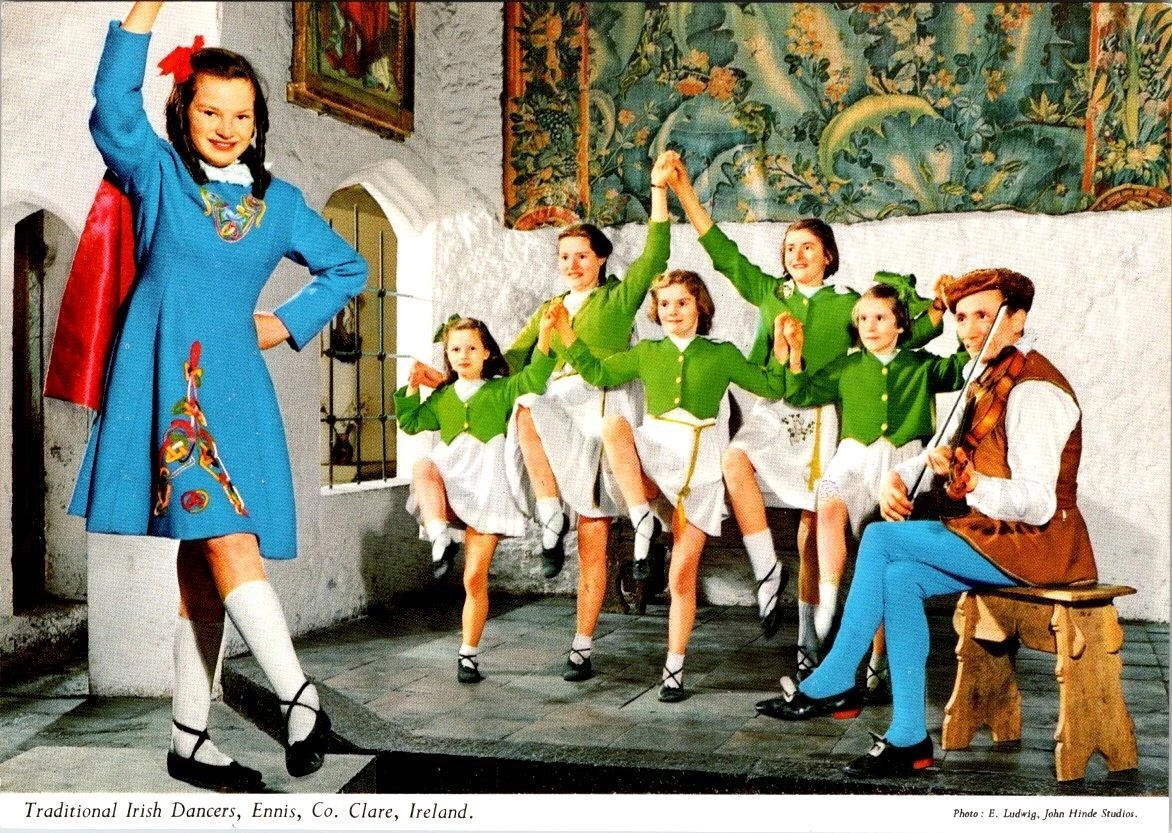
In 1995, thirty years ago at the time of writing, I went with my family to one of the very first performances of Riverdance: The Show at Dublin’s Point Theatre. I had seen Riverdance live on television the previous year, when it debuted as the ten-minute interval act of the 1994 Eurovision Song Contest, and I loved it. I loved it for the skill of its performers: the ways that they turned what I had thought was a moribund art form – Irish dance – into something modern and optimistic. I especially loved the climax when the Irish-American stars, Jean Butler and Michael Flatley performed in front of a long line of until-now amateur dancers. It exhilarated me and made me weep.
Ten years later, having done a PhD, lived in New York, and recently moved to the UK, I went to see Riverdance again at the Gaiety Theatre in Dublin, during its annual summer residency. And I laughed. It was too loud, too sexy, too hyperbolic in its expression of emotion, too vainglorious, too kitsch, too commercial - too much. My critical training and travels meant that the explicit display of Irish skill, which the Riverdance stage show was designed to showcase, no longer enraptured me. Instead, it made me laugh - and feel uneasy.
But that younger self, who watched the first appearance of Riverdance with such astonishment, hasn’t entirely gone away. I still love Riverdance. I still cry when I watch the Eurovision clip on YouTube, despite what the dance show later became. I’m still moved by the end of the piece, when I see the audience roar and leap to their feet and the look of surprise and then glee that registers on the faces of the dancers in response, with Mary Robinson (the first female President of Ireland) laughing and clapping with the rest of them. But most of all, I am still enraptured by the skill of those dancers, by the virtuosity of Jean Butler and Michael Flatley and by the fact that the young amateurs in the chorus line could take the global stage by storm, astonishing an international audience by using skills that they had learned through love.
I return repeatedly to the skill of those Riverdance performers and wonder why their virtuosity is still capable of moving me after all these years, even when the later dance show made me feel so uncomfortable. In this essay, I try to get to grips with the mixed feelings that this work inspires in me. Critical conversations often want us to land on one side or the other, when it comes to our responses to art: we are asked to love or hate the work, to raise it up as exemplary, or to condemn it. But what interests me about Riverdance– and the dance shows of Michael Flatley – is the ambivalence that they provoke in me. What do I do with my mixed feelings when it comes to Irish dance shows?
Let me start with a specific example. At the end of the first act of the 2005 dance show Celtic Tiger, Michael Flatley – the show’s star, choreographer and producer - sang a rousing version of the Irish nationalist ballad, A Nation Once Again. The first half of Celtic Tiger offered a whistle stop tour of Irish nationalist history, which culminated in Flatley’s rendition of the song. The show suggested that Flatley’s virtuosity as a dancer had somehow returned the audience to the nation once again: performance skill had brought them home. The audience response was rapturous, with members of the audience (mostly women) on their feet in the aisles singing lustily in return, matching Flatley’s sincerity with their own exuberant performances.
But this was not the typical critical response in Ireland. Instead, Flatley’s work was condemned as a kitsch account of Irish history and was greeted with widespread mockery. Take Anne Marie Hourihane’s (very funny) essay for the Dublin Review in 2006, where she recounted that: ‘We had laughed so loudly that the woman behind us, my friend said, had hit her deliberately with a handbag, several times.’ Christine Madden also denounced the show in The Irish Times, describing how, ‘The memory of this production's shameless self-promotion, hagiography of Irish/American popular and corporate culture and mediocre aspirations still makes me feel unclean.’
It’s tempting to set up an opposition between mocking critics and adoring fans, between the critic’s knowing condemnation of kitsch and the audience’s unthinking consumption of it .But this isn’t quite right. In fact, critics often own up to their rapture in the face of Flatley’s skill, even as they express discomfort at the narratives he produces. Think for example of Brien Seibert’s response to the show in The New York Times: ‘The trouble is, to see Michael Flatley dancing, you have sit through a Michael Flatley show. This has been the problem for 20 years since he transformed traditional Irish dance into souped-up spectacles.’ In the end, despite Seibert’s disgust at the show’s bombastic aesthetics and excessive showmanship, he still wanted to watch Flatley dancing.
Meanwhile, understanding the audience response to Flatley’s show becomes more complicated when it turns out that moment I’ve described was filmed in Birmingham (England). This was only nine years after Birmingham had held its first public St Patrick’s Day parade for the first time in twenty years, after IRA terrorist attacks in the city meant the parade was banned. Instead, the Irish community were restricted to secretly parading the perimeters of community halls, performing Irishness in limited and contraband ways. Birmingham, the location of the UK’s biggest Irish community, is also a major centre for Irish dance training, with students coming from around the world to train in the form. This was visible at Flatley’s show, with footage of some young audience members in Irish dance costumes dancing in the aisles. For these audience members to sing A Nation Once Again in public, then, was to return to a ‘home’ facilitated by Flatley’s virtuosic performance skill. The ‘nation’ being returned to, however, was not Ireland but Birmingham. The rapture of the audience’s response turned out to be rather more complicated than I had first imagined.
It seems to me that the mix of feelings inspired by this show – what we might call ambivalence - has something to do with the uncanny qualities of the Irish diaspora for Ireland. It wasn’t only that Flatley presented astonishing performance skills, showmanship, and a particular version of Irish history on the stage that discomfited Irish critics. It’s that he is both Irish and American– both a member of the diaspora, and one of the most globally famous exponents of Irish tradition.
Diasporic virtuosi - and the mixed feelings they inspire - were particularly visible during the Celtic Tiger economy (roughly 1990-2008), when the diaspora brought dance “home” in a form that was both familiar and strange for Irish audiences. The Celtic Tiger was characterised by the mass return of migrants to Ireland and the massive increase in the uptake of Irish dance classes across the world. These trends combined in dancers such as Michael Flatley (from Chicago), Jean Butler (from New York) and Colin Dunne (from Birmingham) who were greeted with significant ambivalence in Ireland. Some Irish critics celebrated migrant virtuosi rapturously, with Philip Nolan arguing that, ‘Irish culture is only truly liberated when it is freed from Ireland’, and Fintan O’Toole celebrating the ways Riverdance demonstrated the Irish influence on New York: ‘what was most significant [about Riverdance] was that what was being reclaimed was not just Irish folk dancing, but also the Irish contribution to the Broadway musical.’ But journalists also accused diasporic dancers of exploiting a national resource for imagined personal gain, such as in Kevin Courtney’s claim that: ‘Irish Americans Flatley and Butler have not returned to Ireland to find their own roots, but to borrow a piece of national history and incorporate it into a clever dance routine. They haven't exactly plundered our heritage, but neither do they hold the key to it.’ The diaspora became the target of desire, aspiration and anxiety in equal measure, returning Irish dance to Ireland in a form that was both familiar and strange.
In his 1919 essay, the psychoanalyst Sigmund Freud argued that what is familiar or recognisable to us can become uncanny through a process of repression, where experiences that we find too difficult to encounter directly are ‘put away’ and stored in our unconscious. This means that when we experience something as uncanny (he gives doppelgangers, identical twins, dolls and robots as examples), we are grappling with something we already know but cannot quite confront. The uncanny is an encounter with both the familiar and the strange. Freud links this mental process to the German word ‘heimlich’, meaning ‘homely’ and shows that what is homely or familiar becomes unheimlich - ‘unhomely’ or uncanny -through the psychic process of repression. As he put it, the: ‘uncanny (unhomely) is in reality nothing new or alien, but something which is familiar and old-established in the mind, and which has become alienated from it only through the process of repression.’ The uncanny object inevitably inspires mixed feelings in its beholder, who is simultaneously drawn to and repelled by this combination of the homely and unhomely, familiar and strange.
I’m suggesting here that the ambivalent critical response to diasporic Irish dancers might have come from their unhomeliness – the ways that they made Irish dance and Irishness both familiar and strange. They presented a reminder of the forms of Irish experience that were both known and repressed in the national psyche in Ireland: a recognition of the mass migration and displacement that so manyIrish people were forced to encounter. These dancers both maintained the Irish nation’s familiarity and undid it. The fact that virtuosi like Butler and Flatley had mastered national performance skills beyond the nation state meant that they sustained Ireland’s claims to cultural distinctiveness or specialness in the form of the dance, but did so outside of its territorial borders (borders which in Ireland’s case, have long been fraught and violently contested). They embodied Ireland’s shared heritage, culture and community while simultaneously staging a competing account of histories lived elsewhere. Ultimately, they embodied the nation’s promises to offer its people a home and - in repressed form - its failure to do so. It’s no coincidence then, that Flatley’s show opened with an allusion to the Wizard of Oz with a giant image of a woman’s lips on the back screen, mouthing: ‘There's no place like home.’ Flatley’s dance skill suggested that there was no place like home, but als0 that sometimes home is no place, or that it is always elsewhere.
During the Celtic Tiger period, the depiction of the diaspora ricocheted between aspiration and inclusion to mockery and dismissal. The first female president of Ireland, Mary Robinson, with her invitation to ‘come dance with me in Ireland’, and stage shows like Riverdance in 1995 both imagined the diasporic experience as a rich resource for Ireland. For example, Riverdance’s final scene offered a sense of home that was both in Ireland and everywhere, with its voiceover intoning: ‘We are one kind. We are one people now, our voices blended, our music a great world in which we can feel everywhere at home.’ But to feel everywhere at home is to risk being nowhere at home. While Riverdance supplied a sense of the diaspora – and homelessness itself - as a celebration of aspirational mobility and inclusiveness, other responses were rather more ambivalent.
Take, for example, the widespread mockery that greeted Michael Flatley’s ownership of the stately home Castle Hyde in Cork (the family seat of the first president of Ireland, Douglas Hyde), which he bought in a derelict state, and renovated in 1999. An auction in 2020, selling off the contents of the house, as it lingered on the property market waiting to be sold, was snobbishly lampooned by The Irish Times, connecting his onstage ‘glitz’ to his taste in interiors: ‘Gilt and a rococo style was a theme: gilt mirrors, gilt tables, gilt chaise longue, gilt chess sets.’ Meanwhile, Mario Rosenstock launched a skit on television called ‘Michael Flatley’s Crib’, describing the house as containing ’74 bedrooms, 1 turret, 1 blarney stone and 100,000 welcomes’. The effect was to frame Flatley again as the acquisitive collector of Irish kitsch.
Some of this dismissal was obviously class-based, condemning the working-class (and American) Flatley for his nouveau riche tastes. But I think the implicit discomfort in the critical response goes further – it actually comes from anxiety about the role that the diaspora plays in preserving Irish heritage. For example, journalists focused on the fact that the house’s library contained invaluable first editions of major Irish writers, while the hallway displayed Flatley’s dance shoes and awards and trophies in glass cases. Whether intentionally or not, Flatley’s house implicitly presented his memorabilia as the culmination of national artistic achievement, which had started with Yeats, Wilde and Joyce. Flatley’s home situated him as the end of Irish history. The narrative inbuilt in his collections, resonates with the ways that Flatley became the imagined embodiment of the Irish dance tradition through the success of Riverdance and his own stage shows –and how he was simultaneously accused of that tradition’s exploitation by Irish commentators.
But Flatley had also rebuilt the home that had been lost for the protection of national heritage by the diaspora. Perhaps underneath all this critical mockery was an unease that Ireland depended so heavily on its heritage being preserved by those from elsewhere, who both were and were not Irish. The critical laughter that greeted Flatley’s Celtic Tiger mirrored this ambivalence. It is telling that the song A Nation Once Again came in the middle of the show, not at its end. The foundation of the Irish state concluded the first half of the narrative – but the second half, as with the Riverdance stage show, was set in America. Irish history was shown to lead inexorably to the American dream – and to Flatley himself. Even as the diaspora preserved national traditions, these shows suggested that Irish history must ultimately come to an end, in order for the diaspora’s history to begin.
This historical logic also shapes the kitsch aesthetics of diasporic tourist souvenirs - halting Irish history by insisting on Ireland as a pre-historical place of ‘origin’. Celtic Tiger operated with the logic and aesthetic of the tourist souvenir, performing vignettes onstage that flattened out historical complexity and rendered the famine or the Irish civil war instantly recognisable. It is easy to dismiss kitsch as ersatz and exploitative, and critics certainly did. But Stephanie Rains reminds us that the simplifications of kitsch are the result of diasporic longing and displacement. The returning second or third generation migrant to their country of ‘origin’ may be motivated by a longing for home without ever being able to access the full complexities and meanings of that home. The souvenir supplies this feeling of connection. As she puts it, Irish souvenirs: ‘must display their markers of both ethnicity and experience vividly and in such a way that they will be recognisable with a minimum of cultural 'work' or prior knowledge.’ This is why David Lloyd suggests that diasporic kitsch is always permeated with melancholy, characterised by longing for connection and marked by the loss of history: ‘kitsch is congealed memory that expresses simultaneously the impossible desire to realize a relation to a culture […] and the failure to transmit the past.’
But the story of Irish dance during the Celtic Tiger isn’t only one of longing, loss and displacement. It is also an alternative and more capacious story about what home really means. After all, the uptake of Irish dance training by amateur dancers post-Riverdance wasn’t fuelled purely by a simplistic desire to ‘return’ to Ireland but was rather motivated by the drive to create a home where those dancers were. As the Birmingham audience for Michael Flatley’s show demonstrated, the desire to revisit a nation ‘once again’ comes from a migrant community’s need to create a sense of home that is located in more than one place, that challenges a fixed national idea of belonging. In the end, perhaps the reason that Irish critics felt the need to mock Flatley’s work was because they sensed, ultimately, that it was never really for them. It was for the Irish in Birmingham and the Irish in Boston – making and remaking the nation where they were.
Coda:
Towards the end of Colin Dunne’s 2008 solo dance show, Out of Time, he showed a video clip of himself as a ten-year old champion dancer, displaying his skills on the British children’s television show, Blue Peter. Interviewed afterwards by a Blue Peter presenter with a cut glass RP English accent, she asks: ‘and where do you come from?’ Shyly and breathlessly, Dunne replies: ‘Birmingham’. ‘And where did you learn to do your Irish dancing?’ she asks. Dunne pauses, and a slight look of incredulity crosses his face. He smiles. ‘Birmingham,’ he answers. There is no place like home, but home doesn’t necessarily mean Ireland when it comes to Irish dance.
Works Referenced:
Rosita Boland, ‘Michael Flatley’s house clear-out: from Hannibal Lecter mask for €85,000 to ‘gorgeous cushions’ for €190’, The Irish Times, 26 November 2020.
Kevin Courtney, ‘Go Jump In The Lake, Riverdance’, The Irish Times, December 20, 1994.
Sigmund Freud, ‘The “Uncanny” [1919], in The Complete Psychological Works, Vol. XVII ( London: Hogarth Press 1955 & Edns.), pp.217-56.
Anne Marie Hourihane, ‘A Series of Accidents’, The Dublin Review, Summer 2006.
David Lloyd, Ireland After History (Cork: Cork University Press in association with Field Day, 1999).
Christine Madden, The Irish Times, April 22, 2006.
Angela Moran, Irish Music Abroad: Diasporic Sounds in Birmingham (Newcastle: Cambridge Scholars Publishing, 2012).
James Moran, Irish Birmingham: A History (Liverpool, Liverpool University Press, 2010).
Fintan O’Toole, ‘Unsuitables From A Distance: The Politics of Riverdance’, The Ex-Isle of Erin: Images of A Global Ireland, (Dublin: New Island Books, 1996), pp. 143-156.
Stephanie Rains, ‘Celtic Kitsch: Irish-America and Irish Material Culture’, Circa, Spring, 2004, No. 107 (Spring, 2004), pp. 52-57
Brien Seibert, ‘Review:Michael Flatley’s New Show Has Unicorns, Rainbows and Some Footwork, Too’, NewYork Times, November 11 2015.
Aoife Monks is Professor of Cultural and Creative Industries at Queen Mary University of London and is Director of the Queen Mary Centre for Creative Collaboration. She is currently writing a book about virtuosity and popular performance during the Celtic Tiger economy in Ireland, and is the author of numerous books and articles about theatre costume.